
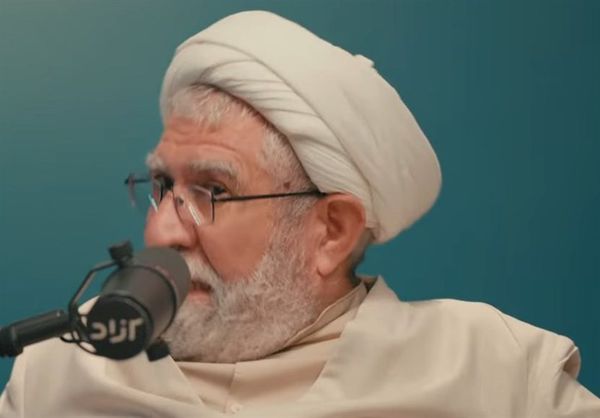
According to Islamic traditions, Soleimani Ardestani's view that "good intention is sufficient and the discussion of justification and justification is not important" is a soft and weak justification for escaping the primary responsibility of faith.
According to Ashura News, quoted by Tasnim News Agency, Saeed Shiri: In the Shiite intellectual system, the two principles of Tawla (friendship and following of the divine saints) and Tabarra (disavowal of their enemies) have been introduced not only as a moral practice, but also as a fundamental principle of belief and a criterion for measuring the level of religiosity. These two concepts, which are considered practical branches of the principle of Imamate and Wilayat, distinguish the Shiite identity from other Islamic sects. Ignoring one of these two pillars has always been the subject of serious criticism by religious thinkers, because complete religiosity without declaring a clear position against right and wrong is considered incomplete.
Recently, a view has been put forward that states that even the martyrdom of pivotal figures such as Hazrat Fatima Zahra (peace be upon her) or the Prophet of Islam (peace be upon him and his family) has no effect on the status and level of individual religiosity, and these figures continue to remain role models. In part of his controversial debate with Hamed Kashani, Abdolrahim Soleimani Ardestani said: “Whether Hazrat Zahra has been martyred or not, it has no effect on her status and my religiosity. Hazrat Zahra is a role model, a guide, and a guide. Whether the Prophet of Islam has been martyred or not, it has no effect on me and makes no difference.”
This view that “good intentions are enough and the discussion of excommunication and tula’i is not important at all” is a soft and weak justification for evading the main responsibility of faith. If good intentions are the only criterion, meaning that you are willing to be good in secret but in practice, avoid taking a clear stance on right and wrong, this is a dangerous passivity; because excommunication and tula’i are not simply a series of slogans or theatrical actions, but are the backbone of defining the identity of a believer. Good intentions without declaring a practical position and clarity in friendship and enmity (on the path of truth) practically turn into expedient indifference and ultimately reduce your belief from a solid foundation to a vague and conservative feeling that will not have any resistance against false intellectual and practical currents.
It must be said that although their exemplary status is permanent, this ignoring of their historical struggle and oppression is in conflict with the spirit of active religiosity that is based on defending the truth. Martyrdom is the peak of oppression and condemnation of the oppressor, and exonerating the murderer is considered part of defending the oppressed.
One of the strong documents for the necessity of abstinence is the luminous words of Imam Ali ibn Musa al-Rida (peace be upon him) who said: “The perfection of religion is our guardianship and our innocence from our enemies; كَمَالُ الدِّينِ وَلَايَتُنَا وَ الْبَرَاءَةُ مِنْ عَدُوِّنَا.” (Bihar al-Anwar (Beirut), vol. 27, p. 58) This hadith clearly shows that Shiite religiosity is a two-way path: connection with the truth (tawli) and severing ties with falsehood (tawli). Without the second dimension, the first connection will not be sufficiently stable, and in times of tribulation, the boundary between friend and enemy becomes blurred.
On the other hand, the life of the infallible Imams (peace be upon them) has always emphasized the necessity of practicing all the pillars of religion with the addition of tuwali and abstinence. Hazrat Imam Musa bin Jafar Kazim (peace be upon him) describes the true Shiites: "Our Shiites are those who perform the prayer... and have the guardianship of the Ahl al-Bayt and seek forgiveness and aversion from their enemies; Our Shiites are those who maintain prayer, pay alms, make pilgrimage to the Sacred House, fast during the month of Ramadan, and support the people of the House. Yatabaroun min aadaeihem.", this narration places Tabari next to the practical pillars of Islam such as prayer, zakat and fasting, and considers it an active element in defining Shia identity. (Sifaat al-Shi’a, p. 4)
The importance of renunciation during the occultation of Imam Mahdi, the master of the time, may Allah hasten his return, becomes doubly important; when maintaining the bond with the Ahl al-Bayt requires more effort. Imam al-Kazim (a.s.) says in this regard: “Blessed are our Shi’a during the occultation of our Qa’im, who have clung to our rope and remained steadfast in our loyalty and aversion to our enemies. Blessed are our Shi’a who cling to our rope during the occultation of our Qa’im, steadfast in our loyalty and aversion to our enemies. Those are from us and we are from them.” This steadfastness indicates that maintaining this active aversion is a vital test during the occultation. (Kamal al-Din and Tamam al-Ni'ma, Vol. 2, p. 361)
The practical tradition of the Prophet's family is another proof of this claim. Imam Ja'far ibn Muhammad al-Sadiq (a.s.) says: "We command our community of Bani Hashim, both adults and children, to curse and hate them; we are the community of Bani Hashim. We command our adults and children to curse and hate them." (Rajal al-Kashi - Ikhtiyar Ma'rifat al-Rijal, p. 207) This shows the adults and children that abjuration is not a hidden or selective teaching, but rather a current and widespread tradition in religious education that must be passed down from generation to generation.
Martyrdoms, especially the martyrdom of Hazrat Zahra (peace be upon her), who in the narrations is the embodiment of the oppressed after the Prophet of Islam, are not merely a historical event, but rather a demonstration of the confrontation between truth and falsehood at all times. If we separate martyrdom from religiosity, we have in fact diminished the jihadi and combative aspect of Islam and reduced it to a purely individual and personal dimension. Therefore, a serious criticism of the thinking that considers the effect of martyrdom on individual religiosity to be zero lies in the fact that this view ignores the social dimension and the belief-based stance based on absolution. Complete religiosity, as the Imams have emphasized, requires holding on to the rope of guardianship and severing ties with any factor that has led to deviation from the path of truth throughout history.
Tula and absolution are the touchstones of distinguishing truth from falsehood in every era. Defending the position of the oppressed Ahl al-Bayt by abhorring the oppressors is the same as piety, and ignoring this oppression is considered an unwitting confirmation of historical oppression. News reports should explain this inseparable link between doctrinal adherence and practical stance to the audience so that a correct understanding of the perfection of religion can be achieved in the shadow of guardianship and innocence.
Post a comment