
Referring to the complex dimensions of recent events, the President said: "Although enemies are seeking to exploit the situation to create inflammation and instability in society, internal weaknesses and shortcomings must also be identified."
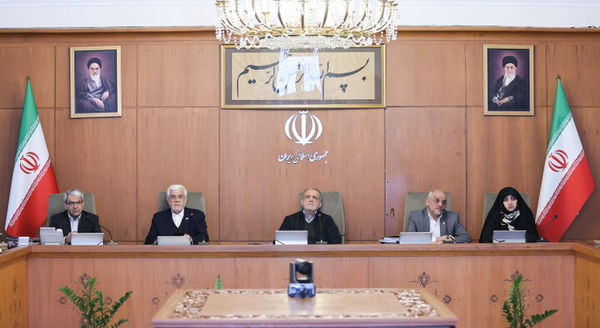
According to Ashura News, citing Mehr News Agency, the 149th Cabinet meeting was held this morning, Wednesday, February 28, 1404, chaired by Masoud Pezzekian, and the most important executive, managerial, social, and foreign policy issues of the country were on the agenda of this meeting.
In this meeting, the President, emphasizing the necessity of field and responsible management of the consequences of recent incidents, mandated governors across the country to form specialized working groups at the provincial level, while meeting in person and continuously with all victims and their families, conduct a detailed, case-by-case, documented, and expert examination of the causes and factors of these injuries, and submit comprehensive reports to the government.
Referring to the complex dimensions of recent developments, Pezzekian stated: Although the enemies of the Islamic Republic of Iran are always seeking to exploit the situation to create inflammation and instability in society, a realistic approach requires that internal weaknesses and shortcomings are also clearly identified and that all responsibilities are not attributed solely to external factors.
Accordingly, the ministries were required to form specialized working groups, while identifying and analyzing the causes of the events, and by holding regular meetings and meetings with various groups, including students, artists, well-known social figures, athletes, and other relevant groups within their mission areas, to provide the basis for effective dialogue, persuasion of public opinion, and pursuit of demands.
The President further ordered the Minister of Justice to take the necessary steps in interaction and dialogue with the judiciary to expedite the process of releasing the relevant prisoners.
It was also emphasized that any negative treatment of artists and cultural and social figures should be avoided and that issues related to them regarding recent events should be pursued and resolved through interaction, dialogue, and internal governance mechanisms.
Pezizkian also emphasized the need to identify management shortcomings and clearly explain the country's positions and actions in the domestic and international arenas.
In another part of the meeting, the issue of integrated customs and border management was discussed and examined in detail, and the Director General of Customs of the Islamic Republic of Iran presented a comprehensive report on the dimensions of the plan, executive requirements, and mechanisms for implementing integrated management.
Referring to successful international experiences in the field of integrated border management, the President called for comparative studies with successful countries, especially neighboring countries, and emphasized that, if necessary, the consulting capacities of countries with successful experience should also be used.
The Minister of Foreign Affairs also presented a report on the latest developments on the international scene and the recent actions of the US government in recent days, and various aspects of these developments were reviewed by the members of the cabinet.
In a note regarding the closure of the "Hammihan" newspaper, Aref called for clear explanations regarding the legal and executive bases of this decision, and stated that the closure of media outlets solely due to criticism requires careful examination and persuasion of public opinion. In this section, the government representative in the relevant committee was questioned, and the Minister of Culture and Islamic Guidance also provided explanations in this regard.
In the final part of the meeting, the measures taken by the General Command of the Islamic Republic of Iran regarding the issuance of motorcycle licenses for women were reviewed, and this issue was approved after being proposed to the cabinet.
According to this resolution, the General Command of the Islamic Republic of Iran is required to provide practical training to female applicants through female instructors in order to organize the process of issuing motorcycle licenses for women, and the examination process will also be carried out with priority for female officers. In the event of a shortage of female officers, the use of qualified male examiners will be permitted, with full observance of Islamic considerations and under the direct supervision of the traffic police.
Also, in line with the macro policies of reducing environmental pollution and reducing dependence on fossil fuels, the Ministry of Industry, Mines and Trade was required, in cooperation with the National Organization of Standards of Iran, to prioritize the design, production and distribution of electric motorcycles, along with related safety requirements and necessities, including standard helmets, anti-lock braking systems (ABS), warning lights and reflective equipment, for the use of all citizens, both men and women, in the country's executive and production programs.
Post a comment