
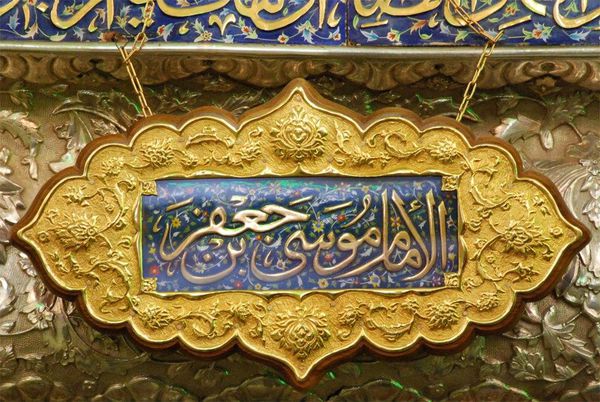
The life of Imam Musa al-Kazim (AS), whose imamate coincided with one of the most difficult and suffocating periods of the Abbasid Caliphate, is a perfect picture of crisis management and religious cadre building.
According to Ashura News, quoted by Mehr News Agency, today is the anniversary of the blessed birth of Imam Musa ibn Jafar al-Kazim (a.s.). The life of Imam Musa al-Kazim (a.s.), whose imamate coincided with one of the most difficult and suffocating periods of the Abbasid Caliphate, is a perfect picture of crisis management and religious cadre building. He took the helm of the nation at a time when the political pressure of the ruling class, especially in the era of Harun al-Rashid, had reached its peak; but what distinguishes his character is the transformation of "political difficulties" into "educational and cultural opportunities." Relying on the two arms of knowledge and forbearance, Imam (a.s.) not only prevented the followers from ideological deviation, but also established a coherent network of lawyers and students that became the foundation of Islamic civilization in the following centuries.
Cultural Strategies and Confrontation with Intellectual Movements
One of the most prominent aspects of Imam Kazim's (a.s.) cultural life was the protection of ideological boundaries against the onslaught of foreign ideas and emerging sects. At that time, with the expansion of the translation movement and the entry of Greek and Eastern philosophies, as well as the rise of movements such as the Mu'tazilites and the Murji'ites, the danger of the convergence of Islamic thought threatened. Continuing the scientific movement of his venerable father, Imam Sadiq (a.s.), the Imam (a.s.) managed the lesson and discussion sessions in such a way that his students became leaders in various sciences, including jurisprudence, theology, and interpretation. In this path, the Imam placed special emphasis on "religious rationality." His famous hadith to Hisham ibn al-Hakam, in which he calls "reason" the divine inner proof, is a Shiite cultural charter in praise of rationality. By explaining the place of reason alongside revelation, he blocked the way for extreme ahadith and false analogies, and presented a systematic framework for deducing rulings and understanding knowledge.
Educational and humanizing models in the Kazemi school
The educational path of Imam Musa ibn Ja'far (a.s.) was based on the axis of "purification before education." He himself was nicknamed "Abd Salih," and this sincere servitude was considered the best model for his disciples. In the Imam's educational approach, a person should be in control of his inner powers; as the title "Kazim" (the one who suppresses anger) indicates the highest degree of individual self-development. In educating his students, the Imam (a.s.) did not limit himself to conveying mental concepts, but sought to build resilient and committed personalities. He taught his companions how to penetrate the heart of the enemy's government (like Ali ibn Yaqtin) and, without losing their religious identity, to unravel the problems of the believers. This method of “organizational education” transformed Shia from a purely religious group into an influential social movement that maintained its connection to the centrality of the Imamate even in the most difficult conditions of imprisonment and exile.
Intelligent Propaganda and the Waqalat Network
Imam Kazim’s (a.s.) propaganda style was designed based on “indirect propaganda” and “networking.” Given the strict supervision of the Abbasid security apparatus, the Imam (a.s.) expanded the Waqalat organization to reach the message of pure Islam to the farthest corners of the Islamic world, from Khorasan to Egypt. This network was not only responsible for collecting funds and redistributing them among the needy, but also, as a powerful medium, conveyed the Imam’s theological and jurisprudential responses to the Shiites. The Imam (a.s.) also approached face-to-face propaganda with great patience and generosity; His encounter with "Busher Hafi" is an example of a transformational preaching that, with just one short sentence, changed the course of a person's life from play and playfulness to asceticism and mysticism. He proved with his behavior that influencing hearts is more effective than physical confrontations.
An important part of the Imam's preaching and cultural life was formed during his long years in prison. Harun al-Rashid intended to cut off the Imam's connection with society by imprisoning him, but the Imam (a.s.) turned the prison into a place of worship and spiritual influence. Historical reports indicate that even the prison guards were influenced by the Imam's educational character and spiritual connection with God. By sending messages and guiding lawyers from within the prison, the Imam (a.s.) did not allow division and despair to prevail in the body of the Islamic society. By standing firm on principles and not giving in to oppressors, he institutionalized the lesson of honor and perseverance as a cultural principle in the history of Shiism. His martyrdom in prison was proof of the legitimacy of a path in which “practical preaching” took precedence over “verbal preaching.”
Today, the life of Imam Kazim (AS) contains fundamental lessons for the Islamic community in the field of cultural management. Emphasis on rational dialogue, training specialized and committed forces, and the use of new methods for communicating with the audience are among the necessities that are clearly seen in his life. Imam (AS) showed that even while surrounded by prison walls, it is possible to assume the intellectual leadership of a nation, provided that the foundation of this guidance is a deep connection with spirituality and a precise understanding of the requirements of the times.
Post a comment