
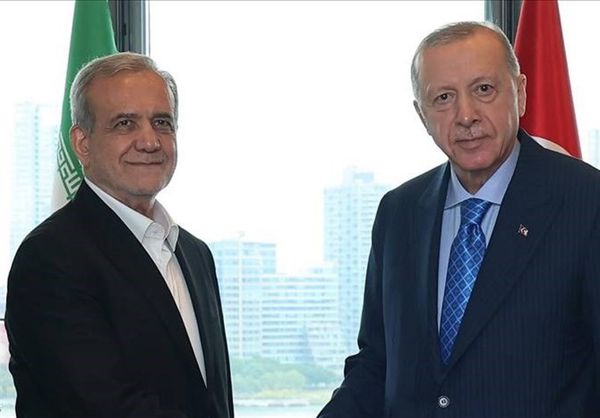
Turkish officials have a clear understanding of the extent of Iran's power and position and consider threats against Tehran to be detrimental to regional stability.
According to Ashura News, citing Tasnim News Agency, the efforts of Iran’s enemies to exploit domestic protests and launch another wave of threats against the country have been at the forefront of regional and world news for a long time. Turkish media also paid serious attention to Iranian issues.
Evidence shows that many Turkish analysts, even in media outlets that have always written with a negative bias against Iran, were well aware of the scenarios of the United States and the Israeli regime at this time and had a realistic outlook.
A review of the positions and statements of officials from the Erdogan government and the Justice and Development Party shows that Ankara officials have a clear understanding of the extent of Iran’s power and status and consider threats against this important regional country to be detrimental to the stability and security of Turkey and other countries in the region.
In other words, without a doubt, part of the Turkish officials’ declaration of support for Iran is rooted in the friendly relations between Tehran and Ankara, and this sense of friendship was clearly evident in the phone call between Masoud Pezzekian and Recep Tayyip Erdogan, the presidents of Iran and Turkey. But it is impossible to simply ignore the fact that Turkey, in any case, while trying to maintain friendly relations, is well aware of Iran's vital role in maintaining regional stability and security and knows that playing with our country's security is endangering stability in the entire region.
Turkish President Recep Tayyip Erdogan and Justice and Development Party leader, Foreign Minister Hakan Fidan, ruling party spokesman Omer Celik, and Turkish Parliament Speaker Numan Kurtulmus were among the officials who emphasized the need to maintain Iran's stability and security during this period.
Erdogan emphasized that Turkey does not accept and opposes any foreign intervention (military or sanctions) in Iran. Meanwhile, the Turkish Foreign Ministry announced in a statement that it is closely monitoring developments related to Iran and considers this situation a threat to regional stability.
Foreign Minister Hakan Fidan also stated in several interviews: "Iran's problems must be resolved through the country's own internal dynamics and Turkey opposes any military intervention.
Fidan has clearly opposed military intervention, stating: “Turkey’s priority is to prevent the destabilization of Iran. Any military intervention could create regional crises. In our view, Israel is specifically looking for an opportunity to attack Iran. This Israeli view is a threat to regional stability. Ömer Çelik, a spokesman for the Justice and Development Party, also warned that foreign interventions will lead to worse consequences.
Analysts’ view
In recent years, the state-owned TRT media group has established an international political research center called TRT World Research Center, which has published analytical reports on Iran in both English and Turkish.
The research institute stated: “Turkey is cautious about using crises to settle geopolitical scores, and the goal is to maintain order and prevent escalation.”
Mehmet Kılıç, an analyst close to the Turkish Foreign Ministry, also says: “Turkey is closely following developments in Iran from the perspective of regional stability and border security. Ankara’s strategy is to avoid foreign intervention and avoid abusing and exploiting crises, and it does not consider calling for regime change in other countries permissible. Turkey has also warned that foreign intervention can lead to increased tension and instability.”
This analysis details the official and unofficial understanding of Turkey’s foreign policy within the overall framework of maintaining stability and preventing the negative consequences of Iran’s instability.
Dr. Golriz Şen, a Turkish analyst and academic, is one of the few authors who, in analyzing the recent situation in Iran, has also referred to the positions of the son of the deposed Shah Pahlavi and considered him to be an ambitious person.
Golriz Şen says: “Reza Pahlavi’s ambition continues. He also made several statements in the past, in two periods, namely after the so-called Mahsa Amini protests and the twelve-day war between Israel and Iran. But this time he showed more enthusiasm for leading the protests. Evidence shows that the interventionist actions of Israel and the United States have given Reza Pahlavi motivation and courage. If not, he has no place in Iranian society, especially among the Turks and Kurds of Iran.”
Turkey: Many analysts, media outlets, and international think tanks have also pointed out the special attitude of Turkish officials towards Iranian security in recent days, reporting that Ankara is closely monitoring all developments in Iran and is concerned about the stability and security of the region.
According to an analysis by Reuters: “Turkey is a cautious actor in the face of Iran’s challenges and wants to weigh everything carefully.”
The European Center for Middle East Studies has also pointed out that Ankara neither supports some of the internal protests in Iran nor seeks to weaken or change the structure of the Iranian political system. In fact, the main concern in Turkey is the fear of widespread instability in the region, security implications, and the influence of foreign actors.
A detailed analysis by the international institute (Middle East Forum) also states that “Turkey sees protests and instability as a direct security threat and does not support foreign intervention in favor of protests or regime change. At the same time, it tries to use dialogue and diplomacy as the main tools for resolving the conflict. Therefore, the Erdogan government prefers to maintain relations with Tehran in order to avoid greater negative consequences and escalation of tensions.
Some foreign analysts specializing in Iran and Turkey studies, in examining Ankara's positions on recent developments, have pointed to the concept of competition and its role in bilateral relations.
Western analysts Dorian Jones has said on this issue: "Ankara considers Iran a competitor. However, relations have become more dynamic, and even in the current situation, Ankara does not want a war or a regime change, but rather wants to strengthen its position in the new regional environment."
Also, Soner Cagpatay, a Turkish researcher at the Washington Institute, says: "Although Turkey opposes Iran's nuclear program, it is not interested in the collapse of the Islamic Republic. Because the loss of stability in Iran could disrupt regional order and harm Turkey's security interests."
In a general assessment and summary, it should be said: From the perspective of Turkish analysts and many international think tanks, Ankara and Tehran are geopolitical rivals, and their interests overlap and differ in many areas in the Middle East. However, this competition is based more on the parameters of regional influence, soft power, and role in crises, and not on a path to weaken and threaten each other's survival.
For example, the ECFR think tank notes that the relationship between Ankara and Tehran is "competition and sometimes cooperation" and that Turkey is not willing to join an anti-Iranian coalition with the participation of foreign forces and military intervention, because such an action would be disastrous for Türkiye's national interests.
Post a comment