
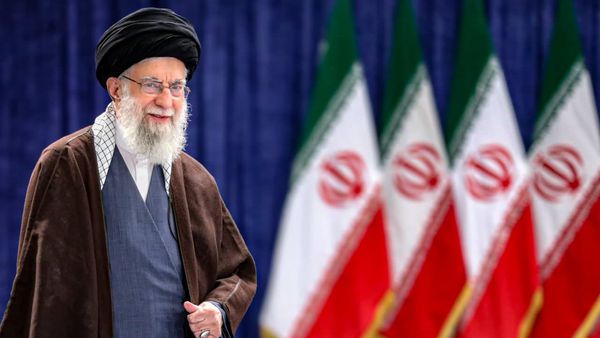
What is the blood price of the martyred leader? Is it summed up in a military response or a temporary action? The truth is that the blood price of every great man is proportional to the ideal for which he lived. If the ideal of the martyred leader of the revolution was to build an independent, powerful, advanced country with national dignity, one of the most important levels of his blood thirst will be to continue on this path.
According to Ashura News, quoted by Fars news agency; And Muhammad is nothing but a messenger before the messengers. God blesses the grateful (al-Imran/144) and Muhammad (pbuh) is nothing but a messenger from God, and messengers have come and gone before him. So if he dies or is killed, do you go back? (And will you abandon Islam and return to the days of ignorance and disbelief?) And whoever turns back, will never harm Allah; and Allah will soon reward the grateful (and steadfast). Indeed, one of the unchanging divine traditions in the history of nations is that the truth does not advance with slogans and claims alone; rather, it is tested in difficult times with great tests. Allah has repeatedly shown that believing communities, after the loss of their leaders and guides, are subjected to a fateful test; a test in which it becomes clear who is attached to individuals and who has believed in the path, ideal and promise of Allah. This tradition is not unique to today and yesterday. Many nations have faced it before. Divine prophets came, fulfilled their mission and passed among the people, but the divine path did not stop. What determined the fate of nations was how they faced these losses. Some continued on their path, while others, at the first shock, retreated and forgot everything.
The history of the divine nations has witnessed this scene again and again. Noah (AS) stood and walked for centuries to guide the people. Moses (AS) led the Children of Israel through the most severe storms and passed away from this world. Amir al-Mu’minin (AS) was martyred in the altar. Imam Hassan (AS) was unjustly poisoned and martyred. Imam Hussein (AS) was dragged to the ground with his companions in Karbala. But the main question has always been: What did the people do after the departure of the saints of God? The greatest divine test usually begins not during the presence of divine leaders, but after calamities and unjustly shed blood. Many people in the time of Imam Hussein (AS) knew that he was right, but when the blood of the son of the Prophet was shed on the ground, they forgot their duty. They neither demanded blood, nor continued the path, nor stood up to oppression. It was this indifference that made them fail one of the greatest tests in history. Today, the main issue is exactly the same. If the bloodlust of our martyred leader is emphasized, it is because society should not become forgetful, accustomed, or indifferent to this great incident. Nations that forget the blood of their elders will gradually forget their ideals. If we press and emphasize the bloodlust of our martyred leader today, it is precisely for this fateful reason. Our loud cry and demand should be why, when we attend international forums, there is no mention of our leader's legitimate right to seek bloodlust? Why is there no emphasis on the clause "commitment not to target the country's officials, especially the Leader of the World's Muslims" during the talks and negotiations?
We must demand the unjustly shed blood of our leader today and ask the authorities not to back down from this vital issue in their domestic and international positions. A clear example of this truth can be seen in the Battle of Uhud. When the rumor of the martyrdom of the Holy Prophet (PBUH) spread among the Muslims, many became anxious. Some left the battle, some thought of compromise, and some even thought that the future of Islam was over. But at the same moment, another group stood up and reminded them of the fact that if the Prophet was killed, the God of the Prophet is alive; if the flag-bearer has disappeared, the flag should not remain on the ground. This is the great lesson of Uhud; real defeat does not occur when the enemy strikes, but when the community hesitates, forgets the goal, and refrains from fulfilling its duty. In that same incident, God taught the Muslims that the axis of movement is not individuals; The axis of movement is the right and duty that has been placed on the shoulders of believers. Today, our society is facing a test of the same kind. The martyrdom of the leader and great personalities of a nation is not simply a political or security incident; it is rather a historical test. A test that shows whether the society will continue their path and ideals or not. It is precisely in such circumstances that the issue of bloodlust becomes meaningful. Bloodlust is not simply an emotional or vengeful reaction; rather, it is a declaration of the truth that by eliminating personalities, the path will not be stopped and their goals will not be forgotten.
If in the Ashura incident, indifference to the blood of the guardian of God became one of the factors of the downfall of society, today, indifference to the pure blood that has been shed for the honor and independence of this nation can also have heavy costs. A society that is insensitive to the blood of its martyrs will gradually become indifferent to their ideals. This is where the issue of deterrence comes into play. Any nation that cannot increase the cost of attacking its leaders, commanders, and strategic figures for the enemy practically paves the way for the repetition of the same crimes. National security is not maintained with military equipment alone; part of national security lies in the fact that the enemy knows that attacking the pillars of a nation will not go unanswered and without cost. For this reason, any dialogue, agreement, or negotiation that is formed about the future of the country cannot be indifferent to this issue. Just as countries demand guarantees to protect their borders, infrastructure, and strategic interests, maintaining the security of leaders and high-ranking figures is also part of a nation’s national security and legitimate rights. A nation that is insensitive to this issue has in fact become indifferent to a part of its future.
But what is the blood price of the martyred leader? Is it summed up in just a military response or a temporary action? The truth is that the blood price of every great man is proportionate to the ideal for which he lived. If the ideal of the martyred leader of the revolution was to build an independent, powerful, advanced country with national dignity, one of the most important levels of his bloodlust will be to continue on this path. A strong Iran is not simply a political slogan; rather, it is the practical translation of that bloodlust. An Iranian whose economy relies on internal strength, whose culture preserves its identity, whose security is not dependent on foreigners, and whose major decisions are not made under pressure from foreign powers, has in fact paid part of the blood price of his martyrs. Every step the nation and officials take on the path of independence, progress, authority, and dignity is a continuation of the path for which the martyrs sacrificed their lives. An Iran that enjoys a resilient and dynamic economy, culture, and security, without selling an iota of its independence and dignity at the price of arrogance. Therefore, the first step in realizing their blood price is an all-out effort to remove the obstacles that stand in the way of achieving such an Iran. But what is this main obstacle? America and the system of domination. So if we are shouting today that America must be expelled from this region, it is precisely because we are seeking to build a strong and powerful Iran.
But achieving such a goal is not possible without “Qiyaam-ul-Lillah.” All the great developments in the history of Islam and the Islamic Revolution have begun from this point; from the moment when humans transcended personal interests and took to the field for God. The force that keeps nations on the field is not merely material calculations; it is faith in a greater goal. The same spirit that at different points in history brought people to the stage and made them resistant to hardships. Today, the most important mission is on the shoulders of the present generation, especially the youth, elites, intellectuals, and cultural and social activists. They must not allow the ideals of the martyrs to become a historical memory. True bloodlust is continuing the path; it is building; it is creating hope; it is strengthening national authority; it is preserving the independence of the country; and it is standing on the principles for which innocent blood has been shed on the ground.
Ahad taught us that after every blow, one can rise again. Ashura taught us that the blood of truth is never wasted. The experience of the revolution has also shown that whenever a nation moves on the path of the uprising of Allah, new paths are opened before it. Therefore, this test is not the end of the road; rather, it can be the beginning of a new stage; a stage in which, by remaining loyal to ideals, maintaining the spirit of resistance, strengthening deterrence, demanding justice, and relying on divine promises, a brighter future will be created for Iran. We will not put down the flag; because we believe that the path of truth does not end with the departure of individuals. The divine tradition has always been like this: those who stick to their covenants continue the path, and in the end, God's promise of victory for the believers will be fulfilled.
Post a comment