
Reducing conflict of regional interests; priority for developing relations between Tehran and Riyadh
The former Iranian representative to the Organization of Islamic Cooperation, indicating that Syria will turn to regional countries, including Iran, said: "Despite the fact that there are problems within the Syrian government and among the rulers, it would be very desirable if Turkey and Saudi Arabia could intervene and resolve these issues."
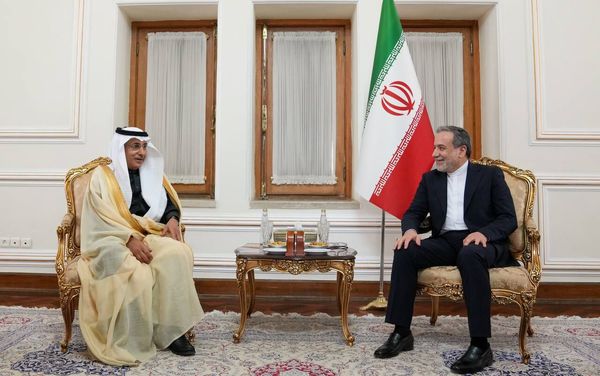
According to Ashura News, citing IRNA, Saudi Deputy Foreign Minister Saud bin Mohammed Al-Sati traveled to Tehran on Sunday, December 29, to consult with officials of the Iranian Foreign Ministry. During his meeting with Foreign Minister Seyyed Abbas Araqchi, the Saudi Deputy Foreign Minister discussed and exchanged views on Tehran-Riyadh bilateral relations and ways to expand relations and cooperation between the two countries in areas of mutual interest, as well as regional and international issues. After meeting with the Foreign Minister, the Saudi Deputy Foreign Minister also met with Mohammad Reza Rauf Sheibani, the Foreign Minister’s Special Representative for Syria.
In a press conference on Monday, Foreign Ministry Spokesperson Esmail Baghai said, in response to a question about the objectives of the Saudi diplomat’s visit to Iran: “This visit is a continuation of a process that began two years ago. Iranian-Saudi relations have continued during this period, and contacts have continued to lay the groundwork at various levels. This visit was also made in this regard. During this meeting, we discussed both bilateral relations between Iran and Saudi Arabia, as well as regional issues that are of common concern to Iran, Saudi Arabia, and other countries in the region, including the issue of occupied Palestine, Lebanon, and Syria, which were discussed and exchanged in the talks between my colleagues and the esteemed minister. This is a process that both countries are determined to continue; a process that is taking place in line with strengthening trust and understanding between the countries of the region, with the aim of advancing common goals and helping to strengthen stability and security in the West Asian region.”
To examine the objectives of the Saudi Deputy Foreign Minister’s visit to Iran and also to assess relations between Tehran and Riyadh, we spoke with Mohammad Shariati Dehaqan, Iran’s former representative to the Organization of Islamic Cooperation.
According to the Ministry of Foreign Affairs, one of the main focuses of the Saudi Deputy Foreign Minister's visit to Iran was to exchange views on regional issues, especially the Syrian issue. What is your assessment of the importance of exchanging views between Tehran and Riyadh on these issues?
In my opinion, Saudi Arabia, as well as countries such as Turkey and Qatar, are countries that can help us in regional issues and even in issues related to the United States. We should use and benefit from the good relations that we want to have with these countries, and we even have good relations with Turkey. Regarding Syria, I had always said before that unfortunately we thought that the Syrian issue, which has created problems for us with the new situation and the change of the Bashar regime, could be resolved through Russia. But at the same time, I also said that Russia cannot seriously solve our issues and even if it wants to, we will have to pay a heavy price in the Syrian issue. Russia itself is facing problems in Syria.
Therefore, Turkey, which has good influence, Qatar, and Saudi Arabia can be our helpers in the new situation; provided that both Syria has balanced demands and Iran puts forward balanced demands, and the media is controlled so that false and insulting accounts are not given to the heads of state. We are faced with several countries in the region with which we may not have had very good relations before, but they are now in power. Our diplomacy knows that it must regulate relations between governments, and if we are dissatisfied with the coming to power of a country or the action that that country has taken, this dissatisfaction should not be reflected in the language of the media, especially the official language in the official media. In the free media and writers can express opinions, but the official language of the media must be such that it uses the official names of governments and officials correctly and respectfully. For example, if the head of the Syrian government is called "Ahmed al-Sharaa", we should also use the same name.
Also, I believe that the visit of both the Turkish Foreign Minister and the Saudi Deputy Foreign Minister is effective both in terms of consensus and in the relationship with the United States; a relationship that, if it becomes tense, will also involve the region. This also goes back to the Syrian case; because Syria initially thought that it could resolve its issues with Israel by declaring that it had no intention of going to war with Israel and by maintaining normal relations. However, the events of the past few months have shown that Israel’s greed and its destructive power, especially in destabilizing Syria, are working, and these actions are real.
For this reason, and in light of the events related to Israel, I believe that Syria will turn to regional countries, including Iran. Therefore, even though there are problems within the Syrian government and among the rulers, it would be very desirable if Turkey and Saudi Arabia could intervene and resolve these issues, and we should also follow this process with a sympathetic and forgiving perspective; Just as other countries on the resistance front, such as Algeria, have adapted their relations to the new situation.
Let's take a look at the relations between Tehran and Riyadh. It is criticized that, contrary to predictions, the relations between the two countries have not developed as expected after the resumption of relations that took place with the mediation of China. Where do you think we are now and what obstacles do we face that still prevent the level of relations, both in the political and economic spheres, from reaching the stage that Tehran intends?
Unfortunately, this situation exists because of the actions. They say that relations between the two countries should not be sought in diplomatic compliments and interpretations, but rather in the media attributed to these countries. The media affiliated with Saudi Arabia do not have a good view of Iran; just as our media do not have a good view of them either. Therefore, it should be known that our relations with Saudi Arabia are not just diplomatic relations and the exchange of ambassadors. Our interests with Saudi Arabia have come into conflict with each other in many countries; such as Lebanon, Syria, Iraq, Pakistan, the countries around us and all the Persian Gulf countries. All these conflicts must be eliminated one by one.
In Lebanon, when Hezbollah conflicts with the Sunni Prime Minister of Lebanon and Hezbollah is also affiliated with Iran, this is a type of conflict that we must reduce. In Syria, when Saudi Arabia supports the current regime and we oppose the current regime, this is also a conflict. In Iraq, when Saudi Arabia opposes groups outside the state as holders of weapons and we agree with such programs, this is also a type of conflict. In Pakistan, groups called Shiites, Sunnis and other groups are also fighting with each other, and these are also considered conflicts.
Therefore, in addition to diplomatic issues, we must eliminate conflicts related to the interests of countries in other countries in order to improve our relations. But we have not been able to resolve these conflicts during this period; Especially in some trips, such as Mr. Larijani's trip to Lebanon, which was interpreted in this way, and the way Hezbollah dealt with it, created the impression that Hezbollah's failure to surrender its weapons was on Iran's advice, while Saudi Arabia is opposed to any armed group outside the state. So there are many contradictions. We also have contradictions on the issue of Palestine, there are also contradictions on the issue of Gaza and support for Hamas. We must reduce these contradictions.
Post a comment